Best Leica Camera for Travel
As an Amazon Associate we earn from qualifying purchases. Some links in this guide are affiliate links — see our affiliate disclosure for details.
There’s a moment on every trip that defines it. For me, it wasn’t the view from a mountain peak or the first sip of espresso in a Roman piazza. It was a moment of sheer frustration in a crowded market in Marrakech.
My camera bag felt like a brick on my shoulder. I was fumbling with lenses, my DSLR drawing curious stares and creating a barrier between me and the vibrant life around me. I was so busy managing my gear that I’d forgotten to simply see. I spent more time reviewing shots on the LCD screen than I did making eye contact with the people who made the place magical.
That night, in a small riad, I made a decision. I needed a different kind of travel companion. It had to be discreet, resilient, and intuitive enough to get out of the way of the moment. It had to be a tool for seeing, not just for shooting.
My search led me to the Leica Q2. And it completely transformed how I experience travel.
The Contender: Leica Q2
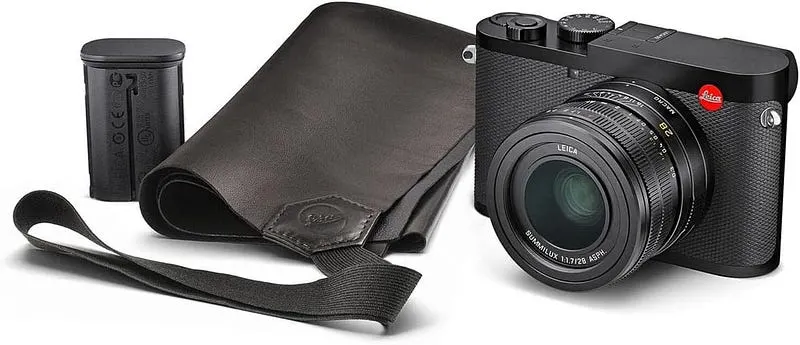
The Leica Q2 isn’t just a camera; it’s a statement of intent. It’s a full-frame compact camera with a fixed 28mm f/1.7 Summilux lens. For the non-techies, that translates to: incredible image quality in a deceptively simple, weather-sealed body.
My Personal Journey with the Q2
My first real test with the Q2 was a week-long hike through the Scottish Highlands. This was the antithesis of my Marrakech experience.
The Weight of Freedom: Slinging the Q2 over my shoulder was a revelation. It’s solid and beautifully crafted — you never forget it’s a Leica — but it’s light. I could walk for miles without a sore neck. My backpack had room for an extra sweater and a flask of whisky instead of a zoo of lenses.
Seeing in 28mm: The fixed 28mm lens forced me to change my perspective — literally. Instead of zooming with my hand, I started zooming with my feet. I had to move, to find angles, to get closer to my subjects. This single limitation became its greatest gift. It made me a more active and engaged photographer. I was composing shots based on my relationship to the world, not on a twist of a lens barrel. The wide aperture (f/1.7) also meant I could capture stunning, sharp portraits with beautifully soft backgrounds, even in low-light pubs.
The “Decisive Moment” Machine: Leica is famous for this concept, and the Q2 embodies it. It turns on in an instant. The autofocus is snappy and accurate. The shutter release is a quiet, satisfying snick rather than a loud, scene-altering clunk. In Edinburgh, I was able to capture a guitarist lost in his music on a rainy street corner without him even noticing. The moment was preserved, not interrupted.
Weather or Not? Oh, weather. It Scotland, it poured. I mean, sideways rain. My old gear would have been buried under a plastic bag. With the Q2, I simply wiped the water off the lens and kept shooting. Its weather-sealing gave me a confidence I’d never had before. The adventure didn’t stop because the weather turned.
The Soul of the Image: This is the hardest thing to quantify but the easiest to see. The images that come out of the Q2 have a certain character. The colors are rich and nuanced straight out of the camera. The sharpness from that legendary lens is breathtaking. I found myself editing less and enjoying more.
Is the Leica Q2 the Best Travel Camera for YOU?
Let’s be real. This is not a casual purchase. It’s an investment. So, who is it for?
The Q2 is for you if:
- You value experience and immersion over having every possible focal length.
- You crave incredible image quality without the bulk of an interchangeable-lens system.
- You appreciate sublime design and a tool that feels like an extension of your hand.
- You want a camera that is built to last and accompany you on adventures for a decade.
You might want to look elsewhere if:
- You need optical zoom for wildlife or sports photography. (The Q2 has a digital crop mode for 35mm and 50mm framelines, but it’s not the same).
- Your budget is tight. There are fantastic travel cameras for a fraction of the price (like the Sony RX100 series or Fujifilm X100V).
- You are a dedicated videographer first. While it shoots great 4K video, it’s primarily a photographer’s tool.
The Verdict
The Leica Q2 did more than just give me beautiful pictures of my travels. It gave me back the travels themselves. It reconnected me to the joy of discovery and the art of observation. It’s a camera that demands your participation and rewards you with a truly authentic experience.
It’s not the cheapest way to take travel photos. But for me, it was the most valuable. It’s the tool that reminded me why I started taking pictures in the first place: not to capture a place I’d been, but to remember how I felt while I was there.
And that, for any traveler, is priceless.

Photo by zakariae daoui on Unsplash

Photo by Matteo del Piano on Unsplash

Photo by Rumman Amin on Unsplash

Written by
Marien CartelProfessional and Certified Digital Photographer born in the USA, with 22 years of experience in the field of photography.
Related Guides
Best Camera for Automotive Photography
What I Actually Reach For When I’m Shooting Cars. Here is how the Canon EOS R5, Sony a7 IV and Nikon Z6 III compare, and the one I keep going back to.
Best Cameras for Virtual Production
After I Wasted a Full Shoot Day Finding Out — why the Sony FX6 and Sony FX9 made the list, and who each one really suits.
Best DSLR Cameras for Beginners: (Guide & Reviews)
My Hands-On Experience with the Best Beginner-Friendly Cameras — why the Canon EOS Rebel T7 and Nikon D3500 made the list, and who each one really suits.